Monday, May 9, 2016

Financial and economic market developments

A notable development these last few weeks has been the change of forward guidance coming from the Federal reserve. The Fed has gradually turned away from indicating that they will have 4 instances of rate hikes. This “dovish” talk has caused the dollar to lose value (relative to global currencies), which means capital may flow into the US and equities can only hope for better performance in coming quarters. First quarter earnings results have been terrible for corporate US.
I’ve been following the negative developments in Venezuela and the following has happened :-
1.     The country is facing runaway inflation, Zimbabwe-style.
Inflation has forced the government to use up its now dwindling cash reserves. Unofficial data indicates an annualised inflation rate of 397.4%
The government will no longer be able to afford printing money yet the President still denies inflation.
Mr. Maduro recently imposed a 2-day work-week for public servants in Venezuela arguing that keeping them home would save energy.
2.     In the face of the low oil prices, the economy is expected to shrink by 8% this year.
3.     There’s a real negative turn that seems to be only getting worse by the days.
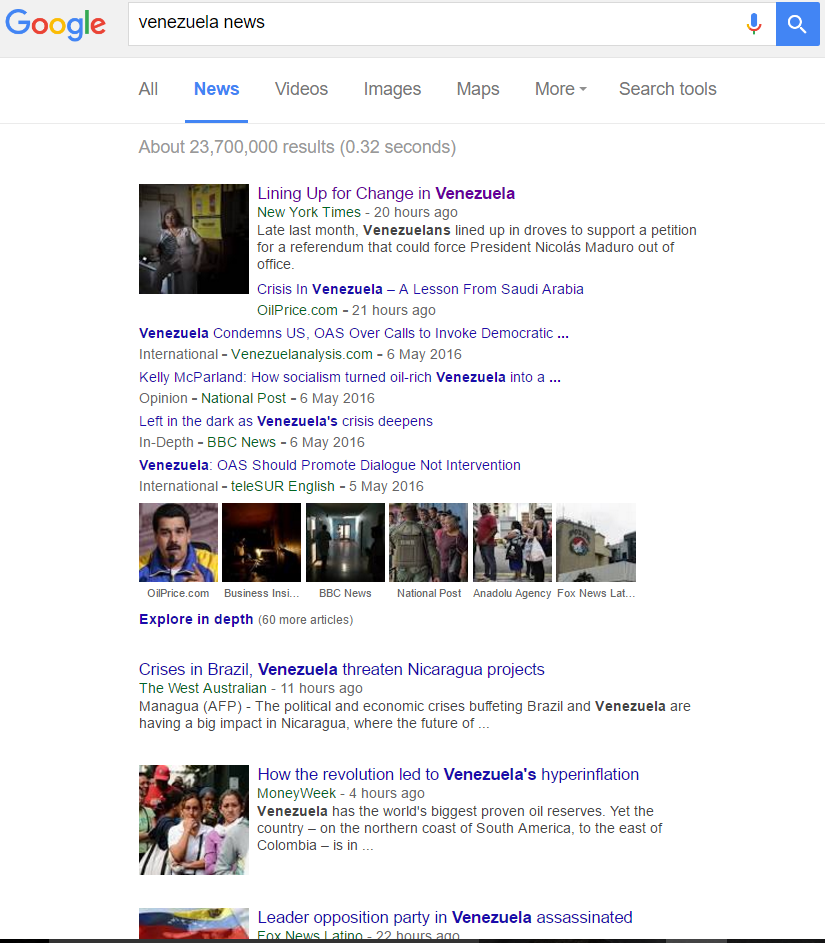
Searching Venezuela news on Google right now (09/05/26) will bring up news of a people working to oust Maduro in a referendum petition. A story that is currently fresh on Reddit will appear that the leader of a regional opposition party leader has only just been assassinated. It gets very grim very quickly down the search results but we can only hope for the best for the people of Venezuela.
In a tide of social unrest that’s getting underway, people are getting desperate for basic necessities like food and medicine.


I expound on a few global risk items and concerns to watch for in the coming quarters as highlighted initially by Preston of The Investors Podcast :-
1.     The impact of negative rates for banks in Europe (Particularly Deutsche Bank)
As I’ve written previously, negative rates are still quite a ‘new’ phenomenon and their effects on the financial markets is one that we have to continually keep watch on. How long will banks in Europe sustain having to pay central banks to hold their excess reserves? How much new lending are banks actually doing? How long will banks accept eroded profits? How much longer will inflation remain low in Europe? Answers to these questions are still developing and so we wait.
2.     A strong Yen pushing Japanese stock prices lower
Japanese stocks and exports that depend on a weak yen are being hammered. The recent major earthquakes in Japan have necessitated a postponement of the tax hike that's expected to be coming Japan's way as well as a delayed early election possibility. 
3.     Chinese Commodity prices returning to reality (because the PBOC pushed commodity prices into outer space during the first quarter)
Action by the PBOC to pump credit into the Chinese economy is a definite watch. The image below courtesy of Stan Druckenmiller through Zero Hedge tells very many stories. A fact for the day from Stan on China would be, “since 2012 the Chinese banking sector has allowed credit to grow by the amount of the entire Brazilian GDP per year!”

4.     Potential impacts of the Saudi currency de-pegging from the US dollar due to the speed and impact of their domestic reserves being spent.  Could cause the dollar to strengthen and put more pressure on US Stocks.
Given that Saudi’s 80% revenue is oil-dependent, prolonged low prices in oil may break Saudi’s peg to the USD some way or another. Although still quite an unlikely event given their still ‘deep’ reserve pockets, markets are pricing a riyal devaluation very highly at the moment, as the Bloomberg currency forward image showed (December 2015). If the Saudi riyal is de-pegged or loosened, the impacts to the global economy would certainly be catastrophic given their position as the biggest OPEC member. The reason Saudi Arabia may want to think about de-pegging would be to prop up revenue as a devalued Riyal would be a great welcome boost. The Saudi oil minister Ali al-Naimi was ousted on Saturday 07/05/16. Mr Naimi had led calls to help re-balance the struggling oil market so his removal may indicate a slower price recovery.


5.     Watch the 2nd quarters US earnings trends.  If earnings continue to slip into the second quarter, things could get ugly for US Stocks.
As Preston, of Investors Podcast noted, US reporting data from quarter 1 was terrible. Fundamentally, growth continues to slow in the US, corporate profit margins continue to decrease and international markets continue to struggle (particularly the Bank of Japan, the PBOC, and European Banks).  Although the market could even run higher, the upside to downside risk/reward continues to be asymmetrical.
6.     Brexit: This could be a big concern for trade and US stocks.
Instability due to an exit of Britain from the EU would be a real concern. The June 23rd referendum is one that all eyes are eagerly going to be watching soon.
7.     High yield debt.  The oil industry supposedly has 3 trillion or more in debt with as much as 50% being estimated as junk.  Some really interesting things could happen here if global demand continues to slip in energy and prices start heading lower again.  I think this is a major concern moving forward, but there is no way of knowing if this trend will return for sure. 
Some expect that this trend will continue but it could go the other way as well. Oil prices are showing some signs of recovering but Iran's recent stint to crank up production may compel Russia and the Saudis to ramp up production as well. These actions would go some way to reverse the current upward trend.

Reference links provided within the post in grey.


Wednesday, March 23, 2016

A economic market review of the last 3 weeks

The last three weeks have seen central banks do what one would probably simply describe as “amazing” stuff as follows; 
§  the Sweden Cut Rates to minus 0.5% from minus 0.35% – in its battle to revive inflation and keep the krona from appreciating. How this works is that lowering the rate to larger negatives is intended to impose a charge on banks when they make their deposits with the central bank. This charge will encourage them to lend thus stimulating the economy and then pushing inflation higher. This doesn’t worry the central bankers because Swedish banks are well leveraged and highly profitable for the charge to be too much of a disincentive in their business.
In terms of the currency, krona, the Swedish central bank, the Riksbank is seeking to control the exchange rate in lowering interest rates as well. How this happens is that negative rates will discourage foreign investors from holding krona and pushing the krona value down which in turn pushes import prices up which gives inflation a further kick.
§  the People’s Bank of China (PBOC) did a series of eye-popping liquidity injections in that same period;
o   starting with a $1.5 billion injection,
o   then another Yuan Devaluation and a $54 billion injection,
o   then another $49 billion injection,
China’s PBOC is releasing extra cash to ensure China’s cash machines are continually oiled. This is a way to ease monetary policy without using the traditional toolkits like interest-rate cuts. By continuing to devalue, China is hoping to encourage investment as they seek acceptance into the international monetary system. A lower yuan means more foreign demand for yuan, boosted export demand due to the devalued prices. Hopefully then a devalued currency will gain the favour of outsiders and economists as China seeks to push on to join the basket of Special Drawing Rights currencies.
§  the ECB cut rates and added more Quantitative Easing (money-printing). The ECB has also sent rates further into the negative territory (-0.4% now from -0.3%) with the hope that it would stimulate bank lending and QE raised to 80 billion Euros from 60 billion a month to provide a boost in liquidity and prevent deflation. Things are not looking so great for the ECB as inflation is moving nowhere as desired and the uncertainties in the world economy are still with us.
§  Norway cut rates to 0.5%. Norway being a big oil producer continues to hurt from the low oil prices.
§  the Reserve Bank of New Zealand cut rates in a shock move that economists didn’t seem to expect. The NZ dollar fell 1% from the announcement but the main reasons to cite for the reserve bank wanting to maintain the lowest interest rate at 2.25% is weak China demand and global growth uncertainties.
§  the US FED cut the number of interest rate hikes for 2016. The sentiment from Janet Yellen the Fed Chis is that the pace at which the FED will hike rates will slow down in 2016. Expectations for growth and inflation have been cut and eyes are on the rate at which the US economy will travel for the remaining year.

Key themes in the world economy continue to be oil, inflation fears and the Fed. The Fed’s decision to weaken the dollar has put great pressure on Europe and Japan (we may even see more devaluations). European banks are in a tight squeeze with the ECB lowering rates and adding more QE as this means they will not be profitable in 2016. These pressures could be negative in a global sense if things worsen. With a weakening USD, commodities (as they strongly correlate to the USD) have gained strength and this has put relief on US banks and lenders that provided capital to the commodities complex. Oil at $40 though may not be sustainable so it will be very interesting to watch what happens in the coming months. 

Reference: Stig and Preston updates for pointers.

Saturday, May 23, 2015

Some visuals from the Australian Federal Budget 2015-16

A 5-page visual of interesting picks arising from the 2015-16 Australian Federal Budget! 

The 'dull' budget can be summed up as an attempt to bring Australia to surplus (Government Revenues > Expenditure) in about 5 years mostly through spending cuts to buckets such as education, welfare and health sectors.


Sunday, March 15, 2015

A few Nobel Prize facts and reflections on economics

Perhaps the most stunning of the Nobel Prize statistics is the fact that for every 1 woman that has won, 18 men would have already won the prize. The common explanation to this 'boy's club' question over the years has been that there have been far fewer women in science than have men, a field in which the Prize is heavily skewed. Assuming that the whole world provided similar opportunities for all and social expectations shifted to accommodate a world where women are treated the same as men, perhaps we shall see more women on the forefront of science, literature and peace in the years to come.
Another interesting conjecture to note is the role economics has played over the years, since 1901. One of the cornerstones of economics is a theory referred to as the rational-expectations theory, the idea that people make choices based on their rational thinking, available information and past experiences. Economists then go ahead and extend this theory to come up with the efficient-market hypothesis, the absurd idea that financial markets reflect all available information and therefore inherently tended towards efficiency and stable risk dispersion. These two theories have been central to mainstream economics for more than 40 years. Most followers of economics can see that these models blind economists to reality and certain that the universe was unfolding as 'in equilibrium', they failed both to anticipate the financial crisis of 2008 and to chart an effective path to recovery. The economic crisis has produced a crisis in the study of economics – a growing realization that if the field is going to offer meaningful solutions, greater attention must be paid to what is happening in university lecture halls and seminar rooms.
Perhaps a great starting point in this reformation exercise should be a denouncement of rational expectations and efficient-market modelling and considering what behavioural economics has to offer; which embodies the mindset that people could actually sometimes be have irrationally and contrary to predictions of economic models. Notable individuals that have won Nobel Prizes in behavioural economics are laureates Gary Becker (motives, consumer mistakes; 1992), Herbert Simon (bounded rationality; 1978), Daniel Kahneman (illusion of validity, anchoring bias; 2002) and George Akerlof (procrastination; 2001).
References: FT website, The Nobel Prize official website.
[DK 15/03/15]

Tuesday, February 17, 2015

Don't blame the whole 'dismal science'!

In response to this interesting article from Business Daily Africa, Why development economics is biggest challenge to growth, I'd say:
It's the massive generalisations within the 'dismal science' that are of concern and that's what should really come under fire, not the whole science. I still think there's some hope if economics is done a little differently. For instance, I'd go straight for the famed General Equilibrium as an example of one massively broken theory that's taught to new economics students so religiously. If you choose to do the unorthodox qual and quant economics (which is what Behavioral Economics mostly stands for and that I'm quite a fan of), I believe the results will be much more palatable to current affairs. For instance - as mentioned by a previous commenter adopting a different risk management methodology, or viewing public and private debt in the truer way that that debt should be looked at in stead of masking it frivolously in the way current  governments are doing (or should have learned not do having been burnt by the recent crisis).Then I believe you will still have some pretty strong cases to lobby the body politic with i.e. call them to action issues like the massive rising income inequalities of the present times, debt escalations (because as clearly experienced in the US with the largely sub-prime loan-backed crisis, when debts rise above a certain threshold, debt deflation kicks in [poor Eurozone is experiencing deflation at the moment], and then asset prices go to the floor).

Wednesday, May 28, 2014

The "Good" Politicians of Canberra

Canberra has taught me a few things over the years and one of them has to be the ability to spot a "good" politician. I say this after being entertained by one Julie Bishop at the Africa Day celebration event on the 27th of May. The celebration is organised by the African diplomatic core and held to commemorate the formation of the Organisation of African Unity in 1963, the organisation which now stands as the renamed African Union. 

To be precise, the statement that has left me as convinced as to think of Julie as a "good" politician boils down to her choice of words when it came to her reference of Australia's aide to Africa. The facts of the recently released budget stand as being that foreign assistance will be frozen and capped to a ceiling with the Department of Foreign Affairs expected to shed some $400m weight through efficiency gains from merging with the Australian Agency for International Development. 
The Government will achieve savings of $7.6 billion over five years by maintaining official development assistance (ODA) at its nominal 2013‑14 level of $5.0 billion in each of 2014‑15 and 2015‑16. From 2016‑17 ODA will grow in line with the Consumer Price Index. The savings include $2.0 billion in 2017‑18 by removing the provision previously set aside for ODA spending.
As part of these savings, the Government has decided to reverse previous decisions to join the African Development Bank Group and the International Fund for Agricultural Development, and has introduced a cap on departmental costs for the Department of Foreign Affairs and Trade (DFAT) to administer ODA equivalent to 5 per cent of DFAT's total ODA budget. (2014-2015 Budget - Paper No. 2 - Expense Measures - Foreign Affairs & Trade)
Julie Bishop referenced the aide that Australia provides to Africa but didn't say at which side, in the north-south map that the monies will be moving to. With some economic insight, one can clearly see the equivalence between "savings", "efficiency gains" and cuts, but with no economic insight and with some eloquently rehearsed off-the-top-of-your-head political language oratory, one can surely fail to see the stark difference as it's nicely disguised within the prose.

With that said, I still thank Canberra for opening up my eyes and driven within me the hunger for in-depth critical analysis. It becomes quite hard to take things as they come once one discovers the facts behind the talk or in this case, the rust beneath the coating. But will the average Australian have the same drive to scrutinise political speech for what it is?

But maybe the story might be different if I'd 

Sunday, August 4, 2013

A Week/end to Remember

It has been a week well worth of a self-titled blog post so here it goes. Interesting enough things happened at the weekend periphery of it not to say that Monday to Friday at work presented nothing to write home about. Friday evening brought along Week 1 of Mizizi Canberra, something Kavee Masila, the current facilitator, had once mentioned to me about 2 years ago in Sydney and is currently finally hosting in Canberra. You can find more information about what Mizizi which means roots in Swahili here and here. In a nutshell,

"Mizizi is a ten weeks experience, tailor made to facilitate you to connect with God, connect with your local church, your purpose and with lifelong friends. As you know, the taller and stronger the tree, the deeper its roots have to be. The same is true about life. If we want to be the kind of people who will fearlessly influence the society and have a long term impact, then we need to know God and grow deeper in our relationship with Him."
Mizizi is a 10 week experience which promises lots to come. And maybe many more blog posts. Week 1 was introductory so I look forward to what the future weeks hold.

Saturday afternoon was moving along like any other with the nitty-grittys of the day like cleaning or the not-cleanings and it's probably the latter that led me to knock at my neighbour's for a hello. I'd met Peter coming from the bus one evening and he'd told me he's staying with his cousin and has been for the last three months. Fortunate enough Loma, the cousin, answered my knock and had some time for a chat (which slowly morphed into an afternoon at my place). Loma and Peter are both studying at the ANU. Loma's also reasonably new to Australia having having only been around 6 months. They are both from Papua New Guinea (PNG).

This wasn't a story my curious door knocking obsession but of how amazed I was to hear and share with Loma a story of his redemption and calling. A story of how the hand of God touched him and gave him a complete roundabout. Loma recounts oh how his life was ground-breakingly touched by God two years ago in PNG and how it has been a different pathway ever since. Peter says that Loma was literally dead but by what he now strongly knows and believes is the grace of God, was healed and is a living testimony of His works. I had to hijack the two into my house because I knew my housemate, Kavee, might also want to hear what these two had to testify (they also got to enjoy some our authentic Kenyan-styled tea in the process). So in my house, for about 3 hours, Loma shared his story with us which physically had me watering. That he has a prophetic message for Kenya also made the experience quite the unique one. That I have lived next door to him and not seen him until now is also unique and I think true to how God works. Loma explained his fascination with Kenya and how he can feel with strong conviction that the country has a a wider role to play in the world stage than it thinks. How there will be a strong leadership for the sake of God's kingdom and what he calls a "revival" being birthed and originated there. Having spent just a few hours with the man, I could clearly see the fear of God in him. As Loma gave an account of his experiences these last two years, I could clearly see he is true to serve and strikingly faithful in the things of God. He a man filled with the Holy Spirit and this clearly presents itself when he prays. That he sometimes goes up Mount Ainslie to pray at night in winter perhaps is one challenge many cant bring themselves to bear but Loma says he strongly believes in prayer and that cold and darkness do not bother him one bit. To me it felt like hitting a jackpot living next door to a man of such great faith. A man who has just started a church in Port Moresby. A church that is made of tent and is yet to have a name but Loma says it is a sanctuary of God. That he plans a crusade function but is not worried about where the money shall come from is true to how faithful he is in waiting for God. Lack of money may deter things but with Loma his motivation is beyond being broken by such material considerations! After all, the church he has planted is a testimony to this. It was really a blessing to share the few hours we did with Loma's family because we did invite them all later on in the afternoon. It seemed like the perfect timing because now both Loma and Peter are also newly enrolled to experience Mizizi with us.

As if that Saturday was not awesome enough, Sunday brought along its own goodness. Our C3 Watson Sunday morning service was graced by Pastors Steve and Deb White from C3 Monash and Steve had a prophetic message for me as he began to speak, "You are redeemed. You cant do anything for it. You need to accept it. You do not need to earn it any more. The price has been paid. You are redeemed." It's hard to write anything following that so I think all I shall say is Amen!

In many many ways God has been faithful through and through and Loma and Peter's story just serve to confirm that. I can not think of anything better than finishing off with Psalm 8:

Lord, our Lord,
    how majestic is your name in all the earth!
You have set your glory
    in the heavens.
Through the praise of children and infants
    you have established a stronghold against your enemies,
    to silence the foe and the avenger.
When I consider your heavens,
    the work of your fingers,
the moon and the stars,
    which you have set in place,
what is mankind that you are mindful of them,
    human beings that you care for them?
You have made them a little lower than the angels
    and crowned them with glory and honor.
You made them rulers over the works of your hands;
    you put everything under their feet:
all flocks and herds,
    and the animals of the wild,
the birds in the sky,
    and the fish in the sea,
    all that swim the paths of the seas.
Lord, our Lord,
    how majestic is your name in all the earth!


Wednesday, November 7, 2012

Issues Obama Must Not Avoid, Again


A cross-post from Truthout Live Blog summarises my thoughts exactly.

History will remember the 2012 presidential election campaign as being among the wackiest, most expensive, least informative, whiplash-inducing events ever seen in real life on this planet. Remember the GOP primaries? The hilarious "anyone-but-Mitt" frenzy that gave the likes of Herman Cain, Donald Trump, Newt Gingrich and Michele Bachmann their own star turn? Magic. That wonderful carnival of nonsense has delivered Mitt Romney and Barack Obama to this, the finish line, at last. No more campaign commercials carpet-bombing the airwaves; after this, you get to be bombarded by Christmas advertising for the next two months. It's almost like a punishment, really. 
-William Rivers Pitt, 06 November 2012
Obama has once again won the votes of the American people but will he lead a congress that tackles real issues that are undeniably of grave importance. To begin with two, an environmental disaster and a nuclear war might be a good start. The UN has recently produced reports on global warming claiming that summer ice may be gone by 2020 and not 2050. I do not see how drilling more oil helps this issue at all. The Obama administration has to rethink its policies on climate change and do more than just promise limiting emissions in   cooperation with other nations of the world.

On the possibility of a nuclear war, the debate is around the US, Israel and Iran. Israel has always refused to sign the non-proliferation treaty which Iran is a signatory to yet it still continues to enjoy US unremitting support. Even though the NPT guarantees nations the right to enrich uranium, we all know that Israel doesn't want this and whatever Israel does not like is almost tantamount to what the US does not like. Would the US go on to bomb Iran if it insists on enriching uranium? Israel insists the only way it can even start talking about a  nuclear free Middle East is if the region is peaceful yet we know full well the misery it inflicts on Palestine.

As Noam Chomsky put it and as I shall plainly relay here, "We could be moving toward a devastating war, possibly even nuclear. Straightforward ways exist to overcome this threat, but they will not be taken unless there is large-scale public activism demanding that the opportunity be pursued. This in turn is highly unlikely as long as these matters remain off the agenda, not just in the electoral circus, but in the media and larger national debate.

Elections are run by the public relations industry. Its primary task is commercial advertising, which is designed to undermine markets by creating uninformed consumers who will make irrational choices – the exact opposite of how markets are supposed to work, but certainly familiar to anyone who has watched television.

It’s only natural that when enlisted to run elections, the industry would adopt the same procedures in the interests of the paymasters, who certainly don’t want to see informed citizens making rational choices.
The victims, however, do not have to obey, in either case. Passivity may be the easy course, but it is hardly the honorable one"

Attributed directly to Noam Chomsky on Issues That Obama and Romney Avoid.

Wednesday, September 5, 2012

Why America and Israel Are the Greatest Threats to Peace by Noam Chomsky

I felt obligated to provide this article here for everyone's indulgence. Easily the most thought-provoking article I've read this month.


Why America and Israel Are the Greatest Threats to Peace by Noam Chomsky
It is not easy to escape from one's skin, to see the world differently from the way it is presented to us day after day. But it is useful to try. Let's take a few examples.
The war drums are beating ever more loudly over Iran. Imagine the situation to be reversed.
Iran is carrying out a murderous and destructive low-level war against Israel with great-power participation. Its leaders announce that negotiations are going nowhere. Israel refuses to sign the Non-Proliferation Treaty and allow inspections, as Iran has done. Israel continues to defy the overwhelming international call for a nuclear-weapons-free zone in the region. Throughout, Iran enjoys the support of its superpower patron.
Iranian leaders are therefore announcing their intention to bomb Israel, and prominent Iranian military analysts report that the attack may happen before the U.S. elections.
Iran can use its powerful air force and new submarines sent by Germany, armed with nuclear missiles and stationed off the coast of Israel. Whatever the timetable, Iran is counting on its superpower backer to join if not lead the assault. U.S. defense secretary Leon Panetta says that while we do not favor such an attack, as a sovereign country Iran will act in its best interests.
All unimaginable, of course, though it is actually happening, with the cast of characters reversed. True, analogies are never exact, and this one is unfair -- to Iran.
Like its patron, Israel resorts to violence at will. It persists in illegal settlement in occupied territory, some annexed, all in brazen defiance of international law and the U.N. Security Council. It has repeatedly carried out brutal attacks against Lebanon and the imprisoned people of Gaza, killing tens of thousands without credible pretext.
Thirty years ago Israel destroyed an Iraqi nuclear reactor, an act that has recently been praised, avoiding the strong evidence, even from U.S. intelligence, that the bombing did not end Saddam Hussein's nuclear weapons program but rather initiated it. Bombing of Iran might have the same effect.
Iran too has carried out aggression -- but during the past several hundred years, only under the U.S.-backed regime of the shah, when it conquered Arab islands in the Persian Gulf.
Iran engaged in nuclear development programs under the shah, with the strong support of official Washington. The Iranian government is brutal and repressive, as are Washington's allies in the region. The most important ally, Saudi Arabia, is the most extreme Islamic fundamentalist regime, and spends enormous funds spreading its radical Wahhabist doctrines elsewhere. The gulf dictatorships, also favored U.S. allies, have harshly repressed any popular effort to join the Arab Spring.
The Nonaligned Movement -- the governments of most of the world's population -- is now meeting in Teheran. The group has vigorously endorsed Iran's right to enrich uranium, and some members -- India, for example -- adhere to the harsh U.S. sanctions program only partially and reluctantly.
The NAM delegates doubtless recognize the threat that dominates discussion in the West, lucidly articulated by Gen. Lee Butler, former head of the U.S. Strategic Command: "It is dangerous in the extreme that in the cauldron of animosities that we call the Middle East," one nation should arm itself with nuclear weapons, which "inspires other nations to do so."
Butler is not referring to Iran, but to Israel, which is regarded in the Arab countries and in Europe as posing the greatest threat to peace In the Arab world, the United States is ranked second as a threat, while Iran, though disliked, is far less feared. Indeed in many polls majorities hold that the region would be more secure if Iran had nuclear weapons to balance the threats they perceive.
If Iran is indeed moving toward nuclear-weapons capability -- this is still unknown to U.S. intelligence -- that may be because it is "inspired to do so" by the U.S.-Israeli threats, regularly issued in explicit violation of the U.N. Charter.
Why then is Iran the greatest threat to world peace, as seen in official Western discourse? The primary reason is acknowledged by U.S. military and intelligence and their Israeli counterparts: Iran might deter the resort to force by the United States and Israel.
Furthermore Iran must be punished for its "successful defiance," which was Washington's charge against Cuba half a century ago, and still the driving force for the U.S. assault against Cuba that continues despite international condemnation.
Other events featured on the front pages might also benefit from a different perspective. Suppose that Julian Assange had leaked Russian documents revealing important information that Moscow wanted to conceal from the public, and that circumstances were otherwise identical.
Sweden would not hesitate to pursue its sole announced concern, accepting the offer to interrogate Assange in London. It would declare that if Assange returned to Sweden (as he has agreed to do), he would not be extradited to Russia, where chances of a fair trial would be slight.
Sweden would be honored for this principled stand. Assange would be praised for performing a public service -- which, of course, would not obviate the need to take the accusations against him as seriously as in all such cases.
The most prominent news story of the day here is the U.S. election. An appropriate perspective was provided by U.S. Supreme Court Justice Louis Brandeis, who held that "We may have democracy in this country, or we may have wealth concentrated in the hands of a few, but we cannot have both."
Guided by that insight, coverage of the election should focus on the impact of wealth on policy, extensively analyzed in the recent study "Affluence and Influence: Economic Inequality and Political Power in America" by Martin Gilens. He found that the vast majority are "powerless to shape government policy" when their preferences diverge from the affluent, who pretty much get what they want when it matters to them.
Small wonder, then, that in a recent ranking of the 31 members of the Organization for Economic Cooperation and Development in terms of social justice, the United States placed 27th, despite its extraordinary advantages.
Or that rational treatment of issues tends to evaporate in the electoral campaign, in ways sometimes verging on comedy.
To take one case, Paul Krugman reports that the much-admired Big Thinker of the Republican Party, Paul Ryan, declares that he derives his ideas about the financial system from a character in a fantasy novel -- "Atlas Shrugged" -- who calls for the use of gold coins instead of paper currency.
It only remains to draw from a really distinguished writer, Jonathan Swift. In "Gulliver's Travels," his sages of Lagado carry all their goods with them in packs on their backs, and thus could use them for barter without the encumbrance of gold. Then the economy and democracy could truly flourish -- and best of all, inequality would sharply decline, a gift to the spirit of Justice Brandeis.
Reproduced as was at Alternet and Chomsky.info on September 3, 2012. I therefore do not own rights to any of the above material. I simply shared it for the aim of spreading the knowledge I think is exemplified therein.

Friday, July 27, 2012

One Day I Will Write About This Place by Binyavanga Wainaina

One Day I Will Write About This Place is perharps Binyavanga’s answer for critics and fans alike following his very famous satirical publication, “How to Write About Africa” with the famous literary magazine Granta(‘Always use the word “Africa” or “Darkness” or “Safari” in your title’, it begins – and goes on to send up every imaginable cliché of writing about Africa.). The publication went on to become Granta’s most read article of all time.
Binyavanga delivers in his memoir details about his time growing up in Kenya, about Uganda, where his mother comes from and South Africa where he attempted his university studies. Like most biographical books, the present continous tense is used and first-person narration is as refreshing as always. Binyavanga owns the story right through the book and the small sentences he likes to employ make the read even easier. The book is socially and politically engaging as it carries you through changing political atmosphere in Kenya as Binyavanga was growing up. His technique leaves one to make suggestions as not much is elaborated on or analysed in great detail.
Both Wainaina’s grounding within his family and his intolerance of development-speak sympathy are apparent in this absorbing memoir.  Wainaina’s childhood is described with swift snapshots of feelings and ideas, capturing the transience of childhood attention. The book unfolds through his adolescence into a sensual maze of discovery and depression. Away from the family, Wainaina peels his thumbnails to the flesh at boarding school and sinks into sordid isolation at university. He is pulled back by his interest in other people, by his patient mother, by a taste for beer, languages and conversation.
Here is the excerpt of the first chapter of the book for you;
Chapter 1
It is afternoon. We are playing soccer near the clothesline behind the main house. Jimmy, my brother, is eleven, and my sister, Ciru, is five and a half. I am the goalie.
I am seven years old, and I still do not know why everybody seems to know what they are doing and why they are doing it.
“You are not fat.” That’s what Mum says to me all the time. “You are plump.”
Ciru has the ball. She is small and thin and golden. She has sharp elbows, and a smile as clean as a pencil drawing. It cuts evenly into her cheeks. She runs toward Jimmy, who is tall and fit and dark.
She is the star of her class. It is 1978, and we are all in Lena Moi Primary School. Last term, Ciru was moved a year forward. Now she is in standard two, like me, in the class next door. Her first term in standard two, she beat everybody and topped the class. She is the youngest in her class. Everybody else is seven.
I stand still between the metal poles we use as a makeshift goalmouth watching Ciru and Jim play. Warm breath pushes down my nostrils past my mouth and divides my chin. I can see the pink shining flesh of my eyelids. Random sounds fall into my ears: cars, birds, black mamba bicycle bells, distant children, dogs, crows, and afternoon national radio music. Congo rumba. People outside our compound are talking, in languages I know the sounds of, but do not understand or speak, Luhya, Gikuyu.
My laugh is far away inside, like the morning car not starting when the key turns. In school, it is always Ciru number one, blue and red and yellow stars on every page. It is always Ciru in a white dress giving flowers to the guest of honor—Mr. Ben Methu—on Parents’ Day. If I am washing with her, we are splashing and laughing and fighting and soon we are in a fever of tears or giggles.
She twists past Jimmy, the ball ahead of her feet, heading for me. I am ready. I am sharp, and springy. I am waiting for the ball. Jimmy runs to intercept her; they tangle and pant. A few moments ago the sun was one single white beam. Now it has fallen into the trees. All over the garden there are a thousand tiny suns, poking through gaps, all of them spherical, all of them shooting thousands of beams. The beams fall onto branches and leaves and splinter into thousands of smaller perfect suns.
I laugh when Ciru laughs and I find myself inside her laugh, and we fall down holding each other. I can feel her laughter swelling, even before it comes out, and it swells in me too.
I know how to move with her patterns, and to move with Jimmy’s patterns. My patterns are always tripping on each other in public. They are only safe when I am alone, or when I am daydreaming.
Ciru laughs loud, her mouth wide and red. The sound jumps toward me, flapping sheets of sound, but I am lost. Arms and legs and ball are forgotten. The thousand suns are breathing. They inhale, dim and cool into the leaves, and I let myself breathe with them; then they puff light forward and exhale, warming my body. I am about to let myself soak inside this completely when I am captured by an idea.
The sun does not break up into pieces.
It does not break up into disembodied parts when it falls into trees and things. Each piece of the sun is always a complete little sun.
I am coming back into my arms and legs and the goalmouth, ready to explain the thousand suns to Jimmy and Ciru. I am excited. They will believe me this time. It won’t seem stupid when I speak it, like it often does, and then they look at me, rolling their eyes and telling me that my marbles are lost. That I cansaythatagain. They are coming close. Jimmy is shouting. Before I fully return to myself, a hole in my ear rips open. The football hits the center of my face. I fall.
Goaaaaal. A thousand suns erupt with wet laughter; even the radio is laughing. I look up and see them both leaning over me, dripping sweat, arms akimbo.
Jimmy rolls his eyes and says, “You’ve lost your marbles.”
“I’m thirsty,” says Ciru.
“Me too,” says Jim, and they run, and I want to stand and run with them. My face hurts. Juma, our dog, is licking my face. I lean into his stomach; my nose pushes into his fur. The sun is below the trees, the sky is clear, and I am no longer broken up and distributed. I scramble and jump to my feet. Juma whines, like a car winding down. I pump my feet forward, pulling my voice out and throwing it forward to grab hold of their Thirst Resolution.
“Hey!” I shrill. “Even me I am thirsty!”
They don’t hear me.
They are headed away from the kitchen, and I follow them into the long clumps of uncut grass at the top of the garden, Juma at my heels, as they weave in and out of Baba’s tractors, swerve to avoid dog shit, run through shade and fading sun, past little eruptions of termites in Kikuyu grass, and forgotten heaps of farm spare parts piled behind the hedge that separates the main house from the servants’ quarters. Then they turn, shouting hi to Zablon, the cook who is washing dishes outside in his white vest and blue trousers and Lifebuoy soap and charcoal smell. I shout hi too, now flowing well into their movements. They stop, then turn to our regular racetrack down the path from the servants’ quarters to the kitchen.
I find them there, Juma’s nose nudging Jim’s leg, and I watch them pour the cool liquid down their throats, from glasses, see it spill off the sides of their cheeks. Jimmy has learned to pull the whole glass of water down in one move. It streams down the pipe, marble-bubbles running down a soft translucent tube of sound, like a frog.
He slams his glass on the countertop, burps, and turns to look at me.
What is thirst? The word splits up into a hundred small suns. I lift my glass and look up. Ciru is looking at me, her glass already empty as she wipes her lips on her forearm.
*   *   *
I am in my bedroom, alone. I have a glass of water. I want to try to gulp it down, like Jimmy does. This word,thirst, thirsty. It is a word full of resolution. It drives a person to quick action. Words, I think, must be concrete things. Surely they cannot be suggestions of things, vague pictures: scattered, shifting sensations?
Sometimes we like to steal Baba’s old golf balls and throw them into a fire. First they curl, in a kind of ecstasy, like a cat being stroked, then they arch, start to bubble and bounce, then they shoot out of the fire like bullets, skinned and free. Below the skin are tight wraps of rubber band, and we can now unroll them and watch the balls getting smaller and smaller, and the rubber bands unfold so long it does not seem possible they came out of the small hard ball.
I want to be certainly thirsty, like Jimmy and Ciru.
Water has more shape and presence than air, but it is still colorless. Once you have the shape of water in your mouth, you discover your body. Because water is clear. It lets you taste your mouth, feel the pipe shape of your throat and the growing ball of your stomach as you drink.
I burp. And rub my stomach, which growls. I fiddle with the tap, and notice that when water runs fast from a tap, it becomes white. Water, moving at speed, rushing from a tap, has shape and form and direction. I put my hand under the tap, and feel it solid.
The shape of an idea starts to form. There is air, there is water, there is glass. Wind moving fast gives form to air; water moving fast gives it form. Maybe . . . maybe glass is water moving at superspeed, like on television, when a superhero moves so fast, faster than blurring, he comes back to himself a thousand times before you see him move.
No. No. Thirst is . . . is . . . a sucking absence, a little mouthing fish out of the water. It moves you from the everywhere nowhereness of air, your breathing person; you are now a stream, a fixed flowing address, a drinking person. It is a step below hungering, which comes from a solid body, one that can smell, taste, see, and need colors. Yes!
But—I still can’t answer why the word leaves me so uncertain and speculative. I can’t make the water stream down my throat effortlessly. It spills into my nostrils and chokes me. Other people have a word world, and in their word world, words like thirsty have length, breadth, and height, a firm texture, an unthinking belonging, like hands and toes and balls and doors. When they say their word, their body moves into action, sure and true.
I am always standing and watching people acting boldly to the call of words. I can only follow them. They don’t seem to trip and fall through holes their conviction does not see. So their certainty must be the right world. I put the glass down. Something is wrong with me.
*   *   *
We are on our way home, after a family day in Molo. We are eatingHouse of Manji biscuits.
Beatrice, who is in my class, broke her leg last week. They covered her leg with white plaster. The water heater in our home is covered with white plaster. Beatrice’s toes are fat gray ticks. The water heater is a squat cylinder, covered in white sticky hard, like Beatrice’s new leg. She has crutches.
Crunch is breaking to release crackly sweetness. Crunch! Eclairs. Crutches are falling down and breaking. Crutch!
Biscuits.
Uganda, my mum’s country, fell down and broke. Crutch!
Field Marshal Amin Dada, the president of Uganda, ate his minister for supper. He kept the minister’s head in the fridge. His son wears a uniform just like his. They stand together on television news, in front of a parade.
I am sleepy. Ciru is fast asleep. Jimmy asks Baba to stop the car so he can pee.
I immediately find I want to pee.
We park on the shoulder of a valley that spreads down into a jigsaw puzzle of market gardens before us. For a long time, I have wanted to walk between the fault lines of this puzzle. Out there, always in the distance, the world is vague and blurred and pretty.
I want to slide through the seams and go to the other side.
After pissing, I simply walk on: down the valley, past astonished-looking mamas who are weeding, over a little creek, through a ripe cattle boma that is covered with dung.
Look, look at the fever tree!
Her canopy is frizzy, her gold and green bark shines. It is like she was scribbled sideways with a sharp pencil, so she can cut her sharp edges into the soul of whoever looks at her from a distance. You do not climb her; she has thorns. Acacia.
She is designed for dreams.
I am disappointed that all the distant scenery, blue and misty, becomes more and more real as I come closer: there is no vague place, where clarity blurs, where certainty has no force, and dreams are real.
After a while, I see my brother, Jim, coming after me; the new thrill is to keep him far away, to run faster and faster.
I stretch into a rubber-band giant, a superhero made long by cartoon speed. I am as long as the distance between me and him. The world of light and wind and sound slaps against my face as I move faster and faster.
If I focus, I can let it into me, let in the whole wide whoosh of the world. I grit my teeth, harden my stomach.
It is coming, the moment is coming.
If I get that moment right, I can let my mind burst out of me and fold into the world, pulling it behind me like a cart. Like a golf ball bursting out of the fire. No! No! Not a golf ball! The world will flap uselessly behind me, like, like a superhero cape.
I will be free of awkwardness, of Ciru, of Jimmy, of Idi Amin dreams. The world is streaks of blinding light. My body tearing away, like Velcro, from the patterns of others.
Later, I wake up in the backseat of the car. “Here we are,” Mum likes to say whenever we come home. My skin is hot, and Mum’s soft knuckles nibble my forehead. I can feel ten thousand hot prickling crickets chorusing outside. I want to tear my clothes off and let my skin be naked in the crackling night. “Shhh,” she whispers, “shhh, shhh,” and a pink-tasting syrup rolls down my tongue, and Baba’s strong arms are under my knees. I am pushed into the ironed sheets that are folded back over the blanket like a flap. Mum pulls them over my head. I am a letter, I think, a hot burning letter, and I can see a big stickysyrup-dripping tongue, about to lick and seal me in.
In a few minutes, I get up and make my way across to Jimmy’s bed.
I strongly encourage you get your hands on a copy of the book and prepare to be entertained.  The book however doesn’t stand up to the consistency of theme in Wole Soyinka’s autobiographies in Aké: The Years of Childhood or even The Man Died: Prison Notes Of Wole Soyinka. I shall surely devote posts to these two books at a later date.
All rights have been reserved in this post. The chapter published is in the public domain and no copyrights have been violated in reproducing it here.

Saturday, May 19, 2012

Just How Efficient is a FORD on Gas

First a disclaimer; I don’t particularly have any hard feelings against Ford but for today, they shall serve as the guinea-pigs in this debate.

When it comes to being fuel efficient and to some extent Eco-friendly, it seems to be quite the trend to have Ford's being the easiest to convert to Liquefied Petrol Gas (LPG) dual fuel systems. I will not dwell too much on the science of Eco-friendliness although I am aware and rightly acknowledge that there is also debate around just how Eco-friendly LPG cars are.

The bone I'm picking today is with Ford's fuel economy. My simple argument is based on the fact that Fords are generally regarded as 'big' cars  and rightfully so. Big here is in the sense of their base 4L engine capacities, for instance in the case of the champion common modern Falcon for instance. Noticeably as well, these cars tend to have taken the leading trend having been designed to be LPG conversion-friendly. Generally, engines with greater capacities are usually more powerful and provide greater torque at lower rpms but also consume more fuel. Even though you argue that most Ford users buy their cars for the towing power, almost about half of Fords I spot on the road today don’t even have a tow bar installed. Clearly Ford knows that consumers want to feel 'big' but in my eyes, I can speculate this to be simple green-washing? I use that word deliberately because common sense would have led one to think that before even thinking about converting or making the Ford's easy to convert to LPG, one would have wanted to reduce the engine capacity in the first place. What saving does burning gas on the same 4L engine bring as compared to the previous system's petrol economy even taking into account the fact that petrol is doubly priced?
I call foul on the way Ford manages to get so much embrace from the Australian Taxi industry yet I'd have imagined that a 3L LPG-converted Toyota might bring a bigger bang for the buck. There is not much of a power loss if you asked me (trust me on that, I drive a 2L engine myself and I'm a pretty happy camper). After all, Subaru's, although turbo-charged, only come with a basic 2L. I reckon it's time we, as Australians, looked to Japan as to how we develop Fords for the future. America I don’t think is near enough to borrow such trends from. My guess is that a litre of water costs less than a litre of petrol in the US which is unfortunately not the case for us in Australia. (And that simple data has nothing to do with the fact that Australia is mostly desert, it's simple comparative economics).

The exception can be made for the good-old towing multitudes out there but then again, I think the car market has in recent years added a lot of awfully close substitutes and a switch from Ford I wouldn't hurt all that much. As a matter of fact, I'd assume the bigger engine would require an LPG refill twice as fast as it did with petrol when new.

So if you happen to churn a 4L machine out of your factory, Ford, I think you should make it standard to have tow bars on it. At least then, we will feel 'big' for one right reason and all that muscle some day may be of some use. As Machiavelli simply put it, "whosoever desires constant success must change his conduct with the times".

Sunday, April 15, 2012

My Gold Benchmark


Every year right around February, which happens to be my birthday month, I like to engage my obsession and look at how gold prices are doing. My base year happens to be 2008 as this is when I can clearly remember having studied and understood how gold works. It also happens to have been the year I started appreciating the Austrian school of economic thinking.

For four years now, this exercise has been quite the exciting one and I can only wish I had some physical gold to have been experimenting with. In February 2008, gold traded at around $900 an ounce and finishing at around $960. In February of 2009, gold fluctuated at from around $900 to finish at a higher $980. In February of 2010 the same ounce would go for around $1080-1110 thereabouts. February of 2011 saw the same upward trend being withheld with gold trading at $1330-1400. This year’s February saw a gold ounce that traded for between $1740 and $1770.
If I’d bought 100 units of gold at $900 in the February of 2009 the same would be worth $177,000 bringing in a profit of $87,000 minus transactional costs. I wonder how many portfolios out there Australian or international can return such an amount over four years.
Until next year, I say watch that ounce.

Saturday, February 11, 2012

The Ever Bold RBA

I must say that the decision by the RBA to leave rates as a stand still is one that leaves me wondering what is up their sleeves given the atmosphere around the world and particularly stemming from Europe. I would have expected a 0.25 drop if nothing more because leaving the rate at its current 4.25% probably might be sending the message that 'we still have our fundamentals in check'. It could obviously turn out to be the best decision for the economy a few months down the line, but if growth stalls and unemployment figures fail to stack up to expectation, I think then that the bank might have to carefully reconsider. Economic growth in Australia still does depend quite considerably on the international state of economic atmosphere and as such, I am yet to hear of very convincing positive rebounds. But then again maybe things will pick up with time as Europe strengthens itself and US makes some flexes. I am also hoping that Chinese lawmakers will continue to hold that economy together as they have managed to do these last few months even amidst of signs of weaknesses in local demand which for us translates to diminishing import figures.

I want to trust that RBA has got better advised information to have been able to make the decision it did in freezing rates but then again who else can we look up to?

Saturday, November 5, 2011

One Day I Will Write About This Place by Binyavanga Wainaina

Not many books excite me as much as this first one from Binyavanga Wainaina has. I will just put the excerpt here and let you decide for yourself. I must add though that I have always had a keen eye for anything written in the tense he prefers to uniquely use, the present tense. And to make it even more interesting what he is narrating is from the past, as a memoir does.

I can not wait to own a copy.

This excerpt is copied directly from the Graywolf Press website. Enjoy.

Excerpt from One Day I Will Write About This Place


 Chapter 1

It is afternoon. We are playing soccer near the clothesline behind the main house. Jimmy, my brother, is eleven, and my sister, Ciru, is five and a half. I am the goalie.
I am seven years old, and I still do not know why everybody seems to know what they are doing and why they are doing it.
“You are not fat.” That’s what Mum says to me all the time. “You are plump.”
Ciru has the ball. She is small and thin and golden. She has sharp elbows, and a smile as clean as a pencil drawing. It cuts evenly into her cheeks. She runs toward Jimmy, who is tall and fit and dark.
She is the star of her class. It is 1978, and we are all in Lena Moi Primary School. Last term, Ciru was moved a year forward. Now she is in standard two, like me, in the class next door. Her first term in standard two, she beat everybody and topped the class. She is the youngest in her class. Everybody else is seven.
I stand still between the metal poles we use as a makeshift goalmouth watching Ciru and Jim play. Warm breath pushes down my nostrils past my mouth and divides my chin. I can see the pink shining flesh of my eyelids. Random sounds fall into my ears: cars, birds, black mamba bicycle bells, distant children, dogs, crows, and afternoon national radio music. Congo rumba. People outside our compound are talking, in languages I know the sounds of, but do not understand or speak, Luhya, Gikuyu.
My laugh is far away inside, like the morning car not starting when the key turns. In school, it is always Ciru number one, blue and red and yellow stars on every page. It is always Ciru in a white dress giving flowers to the guest of honor—Mr. Ben Methu—on Parents’ Day. If I am washing with her, we are splashing and laughing and fighting and soon we are in a fever of tears or giggles.
She twists past Jimmy, the ball ahead of her feet, heading for me. I am ready. I am sharp, and springy. I am waiting for the ball. Jimmy runs to intercept her; they tangle and pant. A few moments ago the sun was one single white beam. Now it has fallen into the trees. All over the garden there are a thousand tiny suns, poking through gaps, all of them spherical, all of them shooting thousands of beams. The beams fall onto branches and leaves and splinter into thousands of smaller perfect suns.
I laugh when Ciru laughs and I find myself inside her laugh, and we fall down holding each other. I can feel her laughter swelling, even before it comes out, and it swells in me too.
I know how to move with her patterns, and to move with Jimmy’s patterns. My patterns are always tripping on each other in public. They are only safe when I am alone, or when I am daydreaming.
Ciru laughs loud, her mouth wide and red. The sound jumps toward me, flapping sheets of sound, but I am lost. Arms and legs and ball are forgotten. The thousand suns are breathing. They inhale, dim and cool into the leaves, and I let myself breathe with them; then they puff light forward and exhale, warming my body. I am about to let myself soak inside this completely when I am captured by an idea.
The sun does not break up into pieces.
It does not break up into disembodied parts when it falls into trees and things. Each piece of the sun is always a complete little sun.
I am coming back into my arms and legs and the goalmouth, ready to explain the thousand suns to Jimmy and Ciru. I am excited. They will believe me this time. It won’t seem stupid when I speak it, like it often does, and then they look at me, rolling their eyes and telling me that my marbles are lost. That I cansaythatagain. They are coming close. Jimmy is shouting. Before I fully return to myself, a hole in my ear rips open. The football hits the center of my face. I fall.
Goaaaaal. A thousand suns erupt with wet laughter; even the radio is laughing. I look up and see them both leaning over me, dripping sweat, arms akimbo.
Jimmy rolls his eyes and says, “You’ve lost your marbles.”
“I’m thirsty,” says Ciru.
“Me too,” says Jim, and they run, and I want to stand and run with them. My face hurts. Juma, our dog, is licking my face. I lean into his stomach; my nose pushes into his fur. The sun is below the trees, the sky is clear, and I am no longer broken up and distributed. I scramble and jump to my feet. Juma whines, like a car winding down. I pump my feet forward, pulling my voice out and throwing it forward to grab hold of their Thirst Resolution.
“Hey!” I shrill. “Even me I am thirsty!”
They don’t hear me.
They are headed away from the kitchen, and I follow them into the long clumps of uncut grass at the top of the garden, Juma at my heels, as they weave in and out of Baba’s tractors, swerve to avoid dog shit, run through shade and fading sun, past little eruptions of termites in Kikuyu grass, and forgotten heaps of farm spare parts piled behind the hedge that separates the main house from the servants’ quarters. Then they turn, shouting hi to Zablon, the cook who is washing dishes outside in his white vest and blue trousers and Lifebuoy soap and charcoal smell. I shout hi too, now flowing well into their movements. They stop, then turn to our regular racetrack down the path from the servants’ quarters to the kitchen.
I find them there, Juma’s nose nudging Jim’s leg, and I watch them pour the cool liquid down their throats, from glasses, see it spill off the sides of their cheeks. Jimmy has learned to pull the whole glass of water down in one move. It streams down the pipe, marble-bubbles running down a soft translucent tube of sound, like a frog.
He slams his glass on the countertop, burps, and turns to look at me.
What is thirst? The word splits up into a hundred small suns. I lift my glass and look up. Ciru is looking at me, her glass already empty as she wipes her lips on her forearm.
*   *   *
I am in my bedroom, alone. I have a glass of water. I want to try to gulp it down, like Jimmy does. This word,thirst, thirsty. It is a word full of resolution. It drives a person to quick action. Words, I think, must be concrete things. Surely they cannot be suggestions of things, vague pictures: scattered, shifting sensations?
Sometimes we like to steal Baba’s old golf balls and throw them into a fire. First they curl, in a kind of ecstasy, like a cat being stroked, then they arch, start to bubble and bounce, then they shoot out of the fire like bullets, skinned and free. Below the skin are tight wraps of rubber band, and we can now unroll them and watch the balls getting smaller and smaller, and the rubber bands unfold so long it does not seem possible they came out of the small hard ball.
I want to be certainly thirsty, like Jimmy and Ciru.
Water has more shape and presence than air, but it is still colorless. Once you have the shape of water in your mouth, you discover your body. Because water is clear. It lets you taste your mouth, feel the pipe shape of your throat and the growing ball of your stomach as you drink.
I burp. And rub my stomach, which growls. I fiddle with the tap, and notice that when water runs fast from a tap, it becomes white. Water, moving at speed, rushing from a tap, has shape and form and direction. I put my hand under the tap, and feel it solid.
The shape of an idea starts to form. There is air, there is water, there is glass. Wind moving fast gives form to air; water moving fast gives it form. Maybe . . . maybe glass is water moving at superspeed, like on television, when a superhero moves so fast, faster than blurring, he comes back to himself a thousand times before you see him move.
No. No. Thirst is . . . is . . . a sucking absence, a little mouthing fish out of the water. It moves you from the everywhere nowhereness of air, your breathing person; you are now a stream, a fixed flowing address, a drinking person. It is a step below hungering, which comes from a solid body, one that can smell, taste, see, and need colors. Yes!
But—I still can’t answer why the word leaves me so uncertain and speculative. I can’t make the water stream down my throat effortlessly. It spills into my nostrils and chokes me. Other people have a word world, and in their word world, words like thirsty have length, breadth, and height, a firm texture, an unthinking belonging, like hands and toes and balls and doors. When they say their word, their body moves into action, sure and true.
I am always standing and watching people acting boldly to the call of words. I can only follow them. They don’t seem to trip and fall through holes their conviction does not see. So their certainty must be the right world. I put the glass down. Something is wrong with me.
*   *   *
We are on our way home, after a family day in Molo. We are eatingHouse of Manji biscuits.
Beatrice, who is in my class, broke her leg last week. They covered her leg with white plaster. The water heater in our home is covered with white plaster. Beatrice’s toes are fat gray ticks. The water heater is a squat cylinder, covered in white sticky hard, like Beatrice’s new leg. She has crutches.
Crunch is breaking to release crackly sweetness. Crunch! Eclairs. Crutches are falling down and breaking. Crutch!
Biscuits.
Uganda, my mum’s country, fell down and broke. Crutch!
Field Marshal Amin Dada, the president of Uganda, ate his minister for supper. He kept the minister’s head in the fridge. His son wears a uniform just like his. They stand together on television news, in front of a parade.
I am sleepy. Ciru is fast asleep. Jimmy asks Baba to stop the car so he can pee.
I immediately find I want to pee.
We park on the shoulder of a valley that spreads down into a jigsaw puzzle of market gardens before us. For a long time, I have wanted to walk between the fault lines of this puzzle. Out there, always in the distance, the world is vague and blurred and pretty.
I want to slide through the seams and go to the other side.
After pissing, I simply walk on: down the valley, past astonished-looking mamas who are weeding, over a little creek, through a ripe cattle boma that is covered with dung.
Look, look at the fever tree!
Her canopy is frizzy, her gold and green bark shines. It is like she was scribbled sideways with a sharp pencil, so she can cut her sharp edges into the soul of whoever looks at her from a distance. You do not climb her; she has thorns. Acacia.
She is designed for dreams.
I am disappointed that all the distant scenery, blue and misty, becomes more and more real as I come closer: there is no vague place, where clarity blurs, where certainty has no force, and dreams are real.
After a while, I see my brother, Jim, coming after me; the new thrill is to keep him far away, to run faster and faster.
I stretch into a rubber-band giant, a superhero made long by cartoon speed. I am as long as the distance between me and him. The world of light and wind and sound slaps against my face as I move faster and faster.
If I focus, I can let it into me, let in the whole wide whoosh of the world. I grit my teeth, harden my stomach.
It is coming, the moment is coming.
If I get that moment right, I can let my mind burst out of me and fold into the world, pulling it behind me like a cart. Like a golf ball bursting out of the fire. No! No! Not a golf ball! The world will flap uselessly behind me, like, like a superhero cape.
I will be free of awkwardness, of Ciru, of Jimmy, of Idi Amin dreams. The world is streaks of blinding light. My body tearing away, like Velcro, from the patterns of others.
Later, I wake up in the backseat of the car. “Here we are,” Mum likes to say whenever we come home. My skin is hot, and Mum’s soft knuckles nibble my forehead. I can feel ten thousand hot prickling crickets chorusing outside. I want to tear my clothes off and let my skin be naked in the crackling night. “Shhh,” she whispers, “shhh, shhh,” and a pink-tasting syrup rolls down my tongue, and Baba’s strong arms are under my knees. I am pushed into the ironed sheets that are folded back over the blanket like a flap. Mum pulls them over my head. I am a letter, I think, a hot burning letter, and I can see a big stickysyrup-dripping tongue, about to lick and seal me in.
In a few minutes, I get up and make my way across to Jimmy’s bed.


From One Day I Will Write About This Place by Binyavanga Wainaina. Copyright © 2011 by Binyavanga Wainaina. All rights reserved.

All rights are obviously reserved and I take no credit personally other than just for review and review only.